Headphones ITH Keyfob: A Craft Fair Seller’s Review
Setting up a craft fair booth means making ruthless creative choices. Every design I stitch has to earn its spot on the table. This week I’m test-stitching and evaluating the Headphones ITH Keyfob Design — a music-themed in-the-hoop machine embroidery file — to see if it belongs in my handmade market lineup. The prompt is simple: a pair of headphones, scaled small, built entirely in the hoop. But the real question is how it sells, how it photographs, and how it holds up when strangers pick it up, twist it, and clip it to a bag right there at the fair.
First Impression: Clean Graphics, Instant Readability
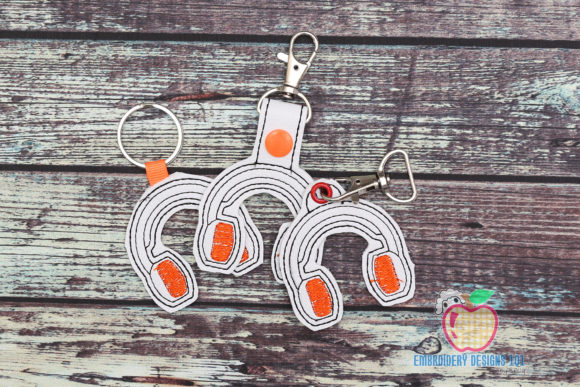
Unzipping the file, I immediately get a graphic that reads modern, bold, and slightly playful. The headphones silhouette is crisp — not too detailed, not too abstract. It lands somewhere between a sleek tech icon and a fun music-festival symbol. At a glance, it tells a story: music lover, creative soul, everyday carry. That instant recognition is golden in a craft fair setting where shoppers walk past dozens of tables in seconds. The design doesn’t whisper. It says “gift for the music person” without a single word.
Because this is an in-the-hoop key fob design, you’re stitching front and back together with a built-in tab, and the file comes with all three key fob hardware versions: snap tab, eyelet, and ribbon. That versatility adds immediate craft fair value — you can offer three distinct finished products from one embroidery file. Some customers want a sturdy snap to hook onto a belt loop; others prefer the soft swing of a ribbon keychain. I can see myself displaying all three styles clipped to a wire grid, each with a different thread palette.
Where This Design Belongs in a Handmade Product Lineup
Let’s be honest: key fobs are impulse buys. They’re small, affordable, and easy to justify at the checkout. The Headphones ITH Keyfob Design takes that impulse energy and channels it into a niche that always shows up at craft fairs — music lovers. Think piano teachers, band students, vinyl collectors, concert-goers, podcast bingers. A design like this doesn’t have to be for everyone. It just has to be the favorite thing for the right person.
While the design is built for key fobs, I always examine whether a motif can travel. Could I isolate the headphones graphic and stitch it onto a corner of a tea towel embroidery project? Possibly. On a flat cotton tea towel, the clean silhouette would work as a small corner accent paired with a music note script. But I’d test first: the original file is engineered for a structured key fob base, often with dense borders and a satin stitch perimeter. If I wanted to use this as an embroidered patch or a pocket accent on a tote bag design, I’d need to check if the design files include a flat-stitch version or if I can split the front layer in my software. A lot of digital sellers don’t include a separate flat motif, so ask before you plan dozens of tote bags. For a handmade product line, I’d keep this design firmly in the key fob category and let it shine where it’s meant to shine.
Snap Tab, Eyelet, and Ribbon: Three Versions Mean Three Chances to Sell
Having all three hardware versions inside one purchase is a huge time-saver. I don’t have to buy three different files. The snap tab version gives a sturdy, professional look that appeals to men and teens. The eyelet version feels classic, and it’s the one I’d use for custom teacher gifts or music studio swag. The ribbon version softens the whole design — ideal for pairing with a subtle print fabric and pastel thread. When I display them together, a buyer can immediately see the difference and often buys more than one “for a friend.” That’s batch-selling at the booth level.
Stitch Density, Small Details, and Practical Production Notes
Any experienced embroidery designer knows that a 4x4 hoop design packed into a key fob size needs careful scrutiny. The headphones graphic will likely have some small inner curves — ear cushion outlines, band connections — and those can turn into a thread blob if the stitch density is too high or the stabilizer isn’t right.
I recommend stitching the first sample on a piece of scrap faux leather or denim that matches your intended key fob material. Check the following:
- Thread thickness — a standard 40wt polyester works well, but metallic or variegated thread might bulk up the detail areas. Test contrast: bright neon headphones on dark fabric pop beautifully, but a dark thread on black vinyl practically disappears.
- Stitch density — in-the-hoop key fob designs often have a dense satin border around the tab to prevent fraying. That’s expected. But check the headphones body; if the fill stitches are too dense on a thin material, the fabric puckers and the finished key fob curls.
- Small lettering issues — fortunately this design doesn’t rely on tiny text. The headphones graphic speaks for itself. That’s a relief because tiny letters on a key fob are the first thing to become illegible after a few weeks in a pocket.
- Hoop size confirmation — the listing states each design is 4x4 hoop friendly, and also mention a 5x7 hoop. Always measure the actual stitch field inside your hoop. A 4x4 hoop has a usable area slightly smaller than 4 inches, and the tab construction needs clearance. The file should fit, but double-check before you run a batch.
- Stabilizer choice — I use a medium-weight cutaway for structured key fob bases, and a tear-away for soft ribbon versions. If your fabric is thick, like cork or heavy canvas, a sharper needle and slower machine speed prevent skipped stitches.
Photographing the Headphones Key Fob for Etsy and Booth Displays
Small handmade products live and die by their photos. The Headphones ITH Keyfob Design photographs well because the silhouette is bold and the shape is symmetrical. I lay one on a flat music sheet, coil a pair of real earbuds around it, and snap a close-up. The headphones motif instantly connects with the prop. For Etsy listings, I shoot all three versions together, each in a different thread color: maybe a mint snap tab, a coral eyelet, a grey ribbon. The variety tells a customer “I can customize this for you,” even if I only offer a few ready-made combos.
When creating a printable mockup or a booth sample, avoid cluttered backgrounds. This design is small — about the size of a key fob — so the eye needs to land directly on the stitch quality. Use natural light and a macro setting. Show the back as well; customers want to see a clean, professional finish on an in-the-hoop piece.
Booth Display Ideas That Turn a Browsing Customer Into a Buyer
I’ll hang these headphones key fobs on a tiered earring stand spray-painted matte black. It looks like a boutique display, not a garage sale. I’ll place a small sign: “For the music lover — snap, clip, gift.” Next to it, I’ll have a few music-themed handmade items — maybe a tea towel with a subtle music note embroidery or a small zipper pouch with a tiny stitched headphone accent. The key fob becomes the entry-level item; the larger products are the upsell. This craft fair product works perfectly as the “hey, that’s cute” piece that draws a shopper to touch and chat.
Commercial Use, Licensing, and File Integrity Check
Before I stitch anything for sale, I read the designer’s terms. The Headphones ITH Keyfob Design is a digital embroidery file, and not every file automatically comes with a commercial license to sell finished key fobs. I need to check if the creator allows sales of finished physical items at craft fairs, on Etsy, and in small shops. Many do, but some limit quantities or require credit. Without that clarity, you risk a policy strike on your Etsy shop or an awkward moment at a handmade market.
Also, confirm the file format: the listing likely includes common machine formats, but always test the file on your machine before a production run. I load it into my embroidery software, preview the stitch sequence, and check that the color stops line up with the hardware steps. A poorly digitized eyelet or tab pull can cause a needle break during the final trim-in-hoop step. A few minutes of testing saves a ruined batch and wasted blanks.
Customer Perception and Perceived Value
A key fob might be small, but it’s a perfect giftable item. Priced right, it sells easily in the $8–$15 range depending on your market and hardware quality. The music theme adds perceived value because it’s niche — not every generic keychain has a personality. The Headphones ITH Keyfob Design brings a sense of identity. A band director buys it for the whole section. A teenager buys one for her backpack. A podcast host includes it as a thank-you gift for guests. None of that happens with a plain rectangle key fob.
Use quality hardware: a sturdy snap tab with a good spring, a split ring that doesn’t bend under finger pressure, a ribbon that’s pressed and topstitched neatly. The embroidery file does the decorative work; you do the finishing work. Together, you create a handmade product that feels professional and durable.
Final Designer Notes Before You Commit to a Production Run
I always keep a checklist for any new machine embroidery design that I plan to sell at a craft fair. Here’s what I’d do specifically for this headphones key fob:
- Test stitch on the exact fabric I’ll use — a sample of faux leather, denim, or cotton canvas. Don’t guess with scrap quilter’s cotton if your real key fobs will be on leather.
- Thread contrast swatch: Stitch one in high-contrast thread (white on black) and one in tonal thread (charcoal on black). See which reads better at a distance.
- Review spacing: The 4x4 hoop version must leave room for the tab construction. If the design is pushing the very edge, switch to a 5x7 hoop for breathing room.
- Create a real mockup: Stitch at least one finished key fob with the chosen hardware. Hang it on a display rack for a day. Does it hang straight? Does the ribbon fray? Does the eyelet hardware feel secure?
- Check commercial terms: If the license says “personal use only,” I can’t sell the finished product. I’ll only buy files that clearly allow small business use.
- Prepare my listing: I’ll photograph three versions, note the size (key fob is roughly 1.5–2 inches wide, estimate), and mention color options. Even a few variations increase the perceived value of a small shop product.
Is the Headphones ITH Keyfob Design Worth the Hoop Space?
For me, absolutely. It’s a low-risk, high-appeal addition to my craft fair inventory. The design translates well to a small format, it’s versatile across hardware types, and it taps into a music niche that’s easy to market. It doesn’t demand a huge fabric investment, and each key fob takes only minutes of machine time once the hoop is loaded. Those are the kinds of craft fair products that let you recover your booth fee quickly and still leave room to experiment with thread colors and packaging.
I’d add a few of these to any table that already has music-themed tote bags, pouches, or pillows. They become the tiny conversation starters that stop a browser and lead to a sale. And if you’re an Etsy seller looking for a fresh embroidery file to round out your digital shop or your physical inventory, this one earns its file space. Just stitch a sample, check your hardware quality, and then watch how a simple pair of headphones makes a shopper smile and reach for their wallet.